
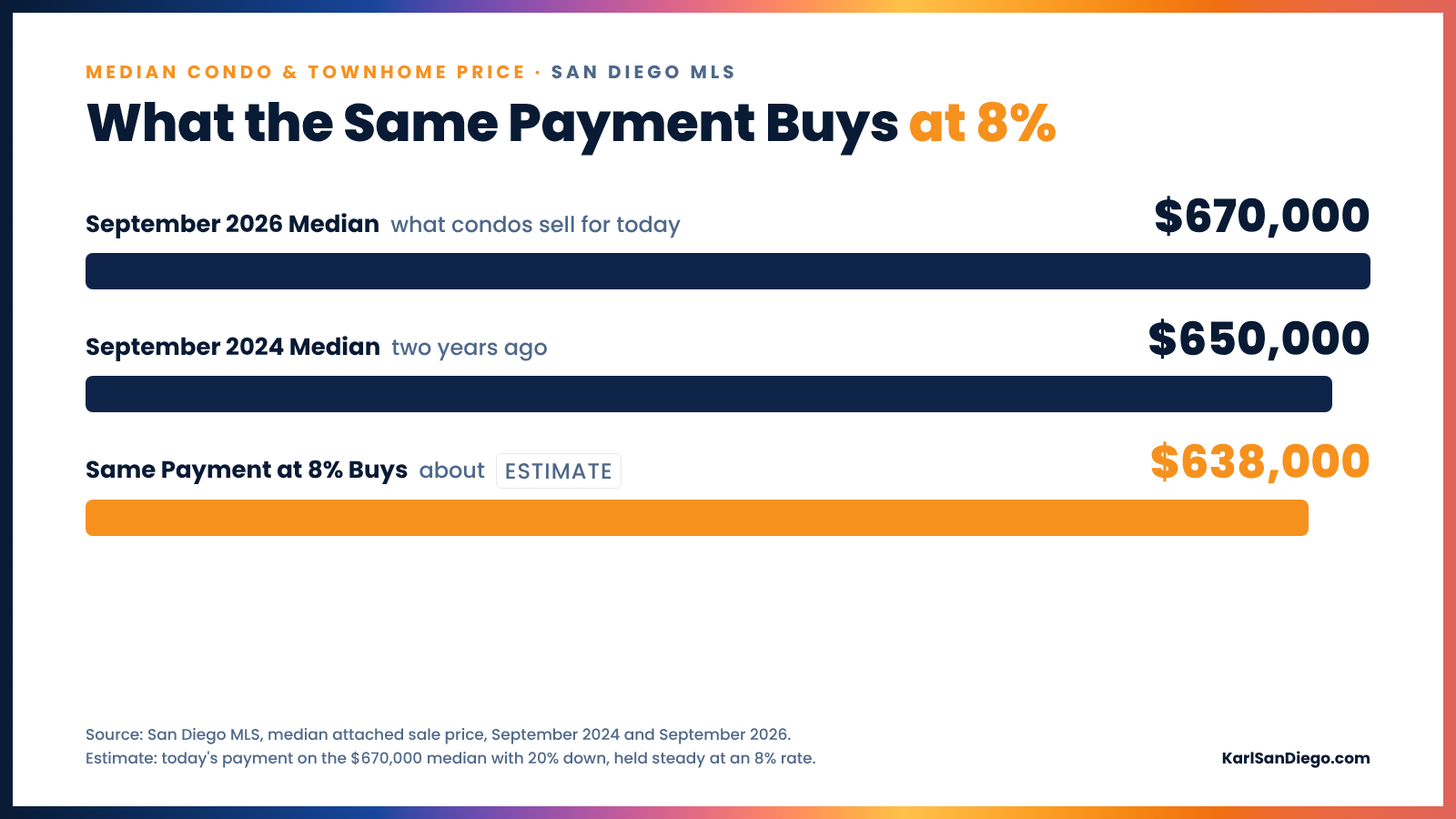
In September, the median San Diego condo or townhome sold for $670,000. Push mortgage rates to 8%, and the monthly payment that buys that condo today only stretches to about $638,000. That's less than the median condo fetched back in September 2024.
Most people see a number like that and expect prices to fall off a cliff. I see something else. San Diego freezes. Buyers pull back, sellers pull back with them, and one corner of the market absorbs most of the damage.
Why 8% Is on the Table
Rates aren't climbing because the economy is struggling. They're climbing because it's running hot. Inflation sits at 3.4%, well above the Federal Reserve's 2% target, and the Fed raised its key rate in September to slow things down.
Your mortgage rate tracks the 10-year Treasury, the return the government pays investors who lend it money for ten years. On October 1st, that yield touched 5.33%, the highest since 2002. HousingWire's Logan Mohtashami lays out how rates get near 8% from here. Treat 8% as a scenario, not a forecast.
Sellers Stay Put
About half of all U.S. mortgages carry a rate under 4%, per the Federal Housing Finance Agency. If you hold a 3% loan, moving means trading it for an 8% loan on a pricier home. Most owners in that spot stay home.
The agency measured this lock-in. Each one-point spread between the rate an owner holds and the current rate cuts the odds of selling by 18%. Its research on 2022 and 2023 found something that flips the crash story. Nationally, the shortage of listings lifted prices by more than higher rates dragged them down.
San Diego went in tight. Detached inventory in September ran almost 13% below a year earlier, with 2.4 months of supply. The MLS calculates that by dividing active inventory by average monthly pending sales over the past twelve months. Below about four months, sellers keep the upper hand.
Buyers Lose Buying Power
Now flip to the buyer. Keep the payment fixed and raise the rate to 8%. Using the source video's 7.49% starting rate, a 30-year fixed loan and 20% down, principal and interest on a $670,000 home is about $3,744 a month. At 8%, that same payment buys about $638,000 with 20% down. This illustration excludes taxes, insurance, HOA dues and other costs.
Condo affordability was stretched before any of this. On the MLS affordability index, attached homes score 62. In plain terms, the median San Diego household earns about 62% of the income needed to qualify for the median condo. At 8%, that gap grows.
Owners hold, and buyers fall out. That's the freeze. And it lands harder on some homes than others.
Condos Take the Hit
Picture someone who bought a condo two or three years ago. They never got a 3% rate. They got 6% or 7%, and their home has barely gained value.
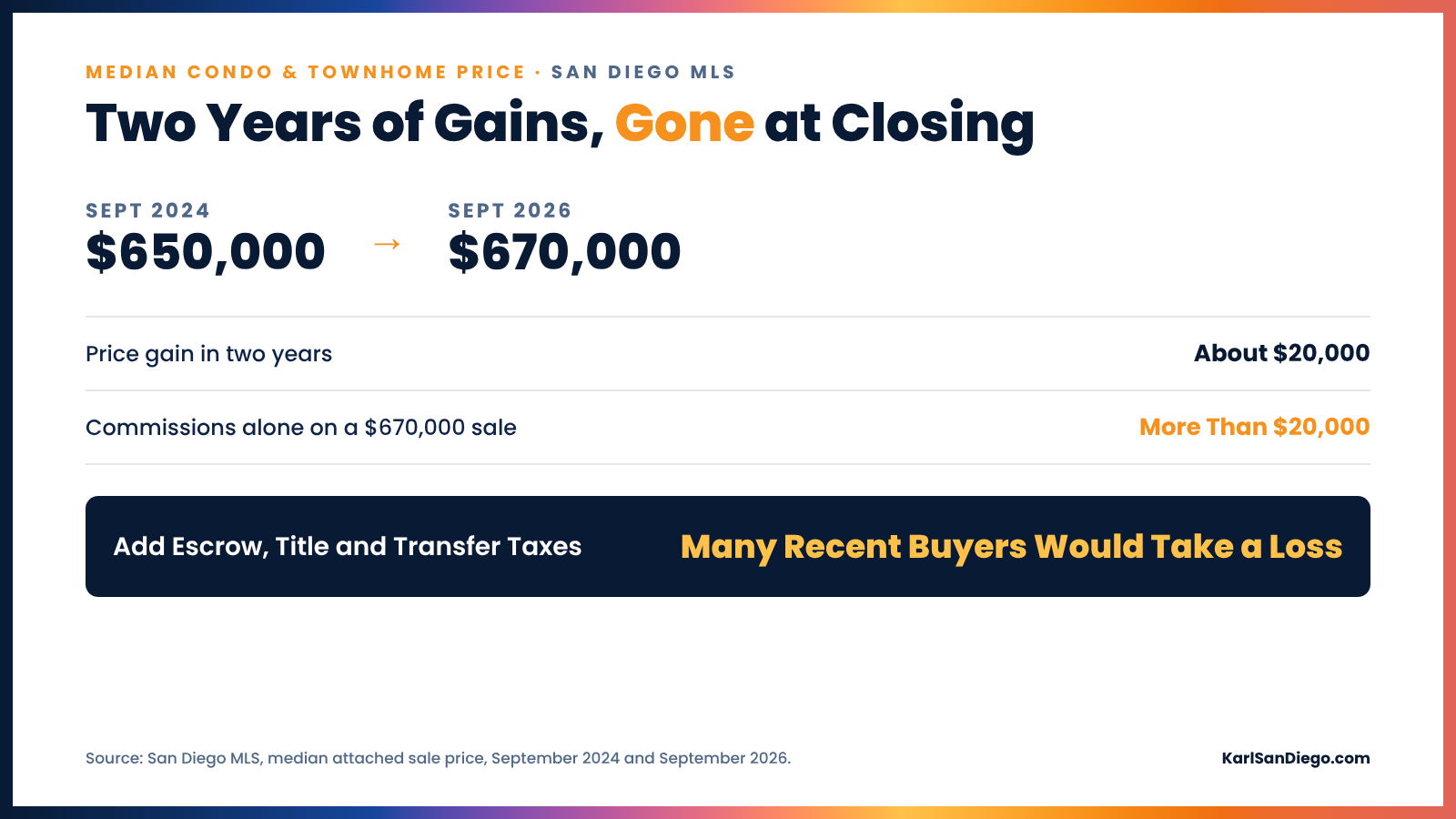
The median attached home went from $650,000 in September 2024 to $670,000 this September. That's a gain of about $20,000. At an illustrative total commission of 3%, a $670,000 sale would cost $20,100 in commissions. Commissions are negotiable and vary by agreement. Stack escrow, title and transfer taxes on top, and that gain disappears. A market median does not measure the gain on any individual home. Selling costs can erase a small price gain; the actual outcome also depends on the purchase price, down payment, loan balance and other costs.
The condo sellers who list anyway are the ones with no choice, after a job loss, a divorce or a death in the family. A price below what they paid does not by itself mean a short sale. If net sale proceeds cannot cover the mortgage debt, the owner may need lender approval for a short sale, where the lender accepts less than the loan balance.
Detached Homes Stall
Detached homes behave differently because a different crowd buys them. Move-up buyers, investors and first-time buyers who want no HOA make up that pool. A move-up buyer is also a seller, and their equity softens a higher rate. When they stay put, one listing and one buyer leave together. Both sides shrink, and prices go flat instead of down.
My Take
At 8%, San Diego doesn't crash. It stalls. Low-rate owners stay put, buyers lose purchasing power, and those two forces offset each other more than most people expect.
I don't see 8% as a gift to buyers. I see it leveling the negotiating power between both sides. In detached homes, that shift is small. In condos and townhomes, it's bigger, and that's where both the pain and the opportunity show up. Bought a condo in the last few years? Don't list out of fear. If you have to sell, call me before you're out of time.
Watch the Full Video
This post covers why 8% would freeze San Diego instead of crashing it. The full video goes further. I break down the monthly payment math at 8% and 8.5%, why brand-new build-to-rent apartments are pulling renters away from older condos, the trap of a listing that's sat for 90 days, what buyers should ask sellers for in a market like this, and how sellers should price their home.
Watch the full video on YouTube
If you have any questions or concerns, don't hesitate to reach out.
As always, I'm Karl Kyler, your San Diego Realtor.
Karl Kyler · Karl San Diego
eXp Realty of Southern California, Inc.
KarlSanDiego.com · 619-829-2908
DRE #01439839
Sources and assumptions
- September 2026 San Diego MLS report
- FHFA — The Lock-In Effect of Rising Mortgage Rates
- Karl’s October 9 video and supplied research script; the rate and economic readings reflect its historical scenario.