
Proposition 37 reaches your ballot on November third. It would authorize up to twenty-five billion dollars in revenue bonds to fund second mortgages for qualifying homebuyers.
The mechanics are simple enough. A buyer contributes three percent. The proposed program would lend up to another seventeen percent as a second mortgage. That loan is junior to the first mortgage in lien priority; this does not mean its payments necessarily wait until the first loan is paid off. CalHFA would set the interest rate and repayment terms. Stack the two and you arrive at twenty percent down, the threshold where private mortgage insurance falls away. That insurance protects your lender in a default and returns nothing to you, so shedding it saves real money every month.
Reasonable so far. Then comes the eligibility rule, and the program shrinks.
One Word in the Ballot Title Does All the Work
Read the official title voters see: "Creates Loan Program for Middle-Income Buyers of Qualified New Homes."
That word new is doing an enormous amount of work.
An eligible property means a brand new build, or the first sale of a structure converted out of some other use. Turn an empty office tower into condos and it counts. A Clairemont house from 1985 never will.
Now weigh that against what sells here. We are a resale market. Month after month, the bulk of our closings are previously owned homes trading hands. The eligibility rule removes almost all of it before anyone argues about whether the policy is sound.
The $28,000 Figure on Television Describes the Wrong House
A graphic has been circulating that puts our county average at $934,000, with three percent of it working out to $28,000. The implication is that twenty-eight thousand dollars gets you across the finish line.
Two things are wrong with it.
One, that average home is not purchasable under this program. New construction only.
Two, a countywide average mixes condos and detached houses into a single figure describing neither. Our August attached median landed at $670,000. Detached landed at $1,120,000. The televised number floats between them and belongs to neither sector.
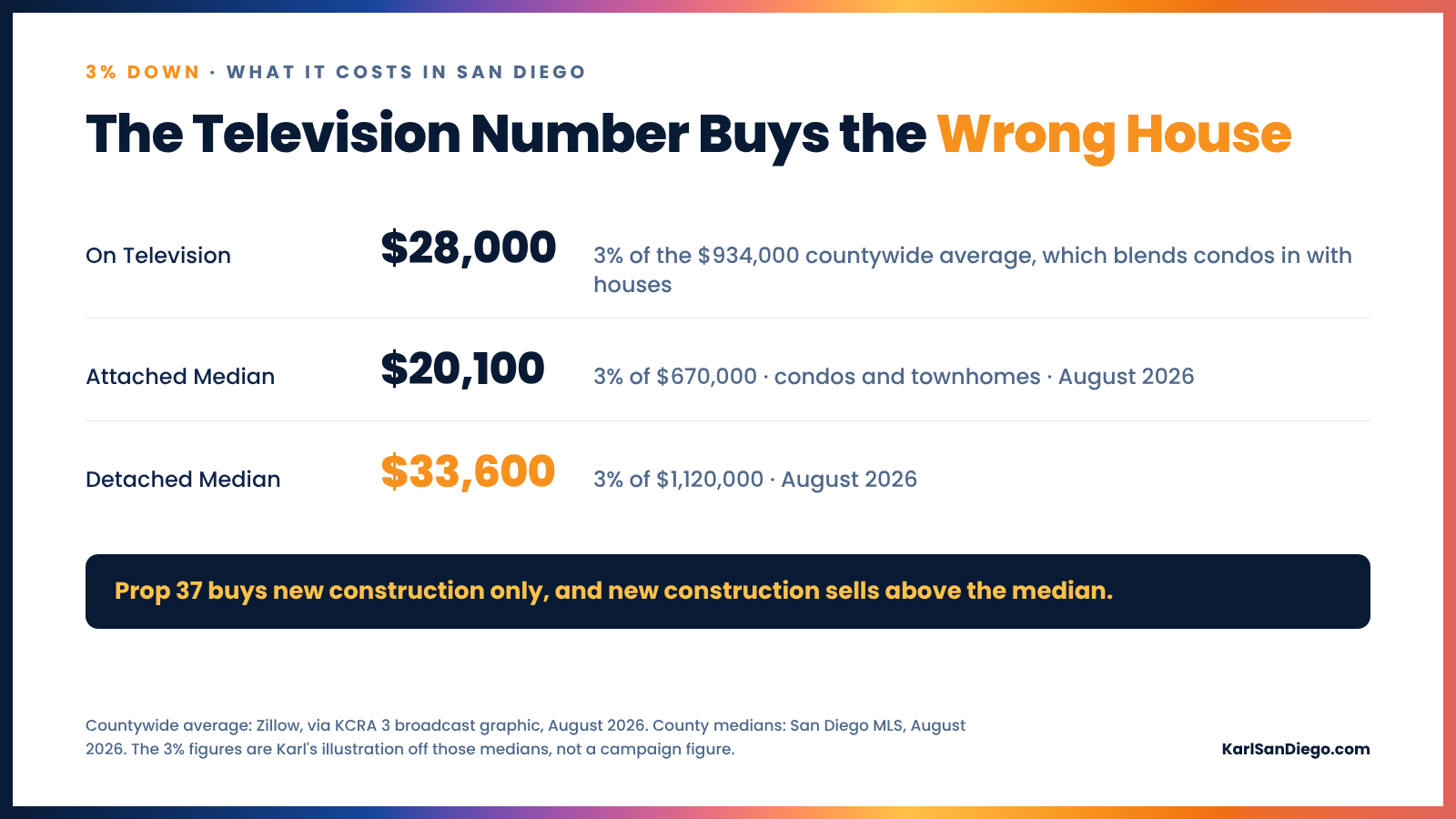
Apply three percent to each and your entry figures become $20,100 and $33,600. I ran those off my own MLS data as an illustration, and the campaign never published them. These are all-market medians, not prices for qualifying new homes. A particular new home can cost more or less; check actual eligible listings.
This Is Not a Low-Income Program
Eligibility surprises people more than anything else in the measure.
Qualifying income tops out at two hundred percent of area median income. AMI is the midpoint earnings figure for a given county and household size, so doubling it sets a high bar.
The income test uses area median income and household size. Confirm the applicable dollar ceiling against the program’s income schedule; an income figure alone does not establish eligibility.
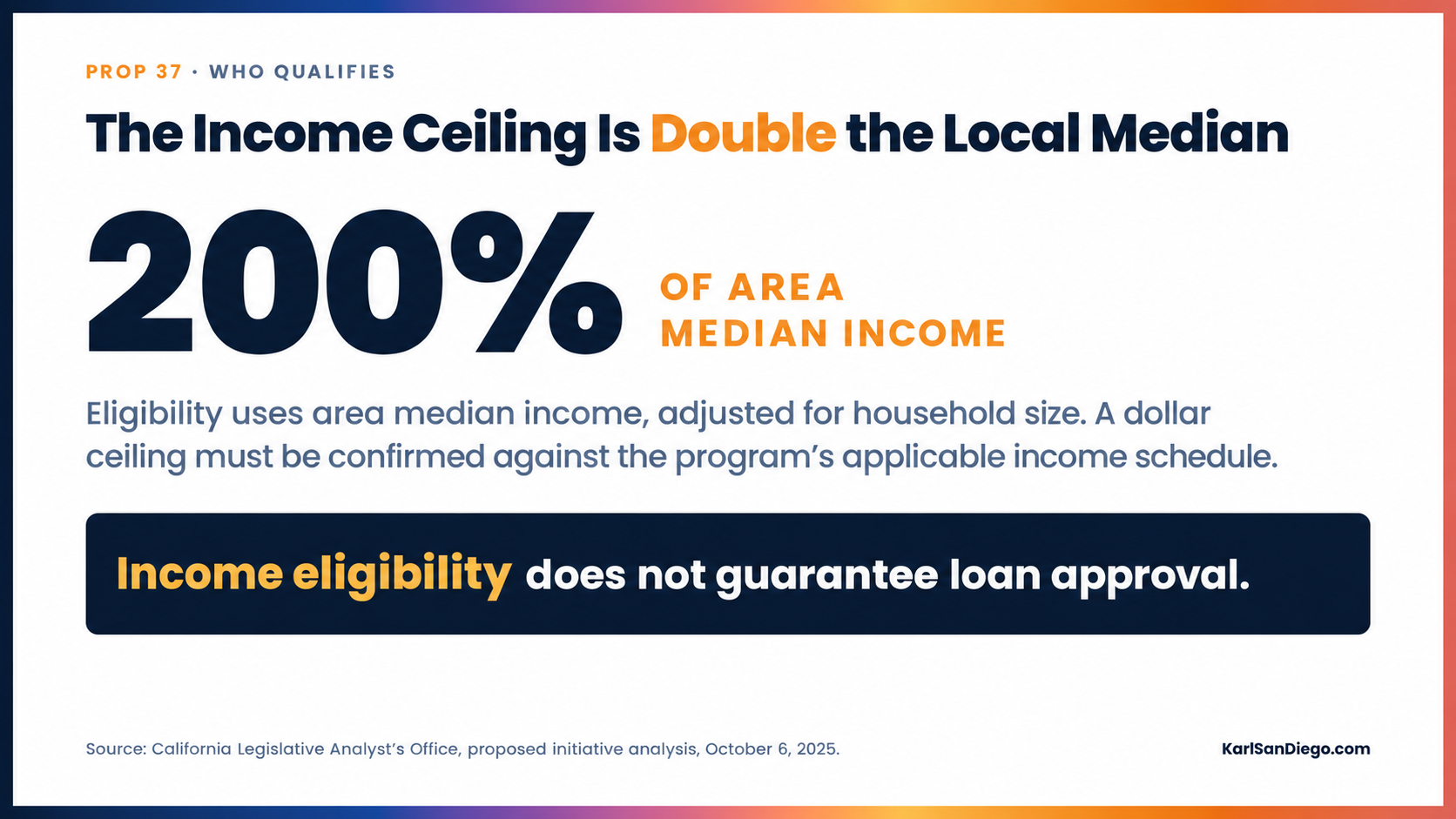
This is aimed at middle-income buyers, rather than being limited to low-income households. The proposal also requires California residency for at least a year, owner occupancy, a qualifying first mortgage and other eligibility conditions.
Then Subtract What San Diego Builds
This next part comes from working the market rather than from a published figure, and I want that labeled plainly.
Construction is happening here. What I watch go up are accessory dwelling units behind existing houses, lots getting split, and new product arriving one or two homes at a time. Volume is the missing piece.
Our large projects went rental. Developers took the sites capable of producing real inventory and built apartments on them instead. Hillcrest, University Heights, Bankers Hill, Little Italy and downtown have each absorbed sizable developments, and essentially none of those doors will ever carry a listing. Homes retained as rentals are not offered to buyers through this program. Future eligible conversions would need to meet the measure’s requirements.
So run the eliminations. Resales fail the test. Rentals never reach a buyer. Anything above the price ceiling drops out as well. Whatever sliver survives all three cuts is the real target of twenty-five billion dollars in this county.
Where That Leaves You
Prop 37 would offer repayable loans, not grants. It does not directly build homes.
The wager underneath it is that demand will summon supply. Winning that wager requires builders producing for-sale homes at volume, which is precisely what San Diego does not do. The measure might work somewhere else. Here, the inventory it depends on barely exists.
My suggestion if you are still weighing it: pull up the qualifying new construction within range of where you want to live and read the real prices. Skip the countywide averages. An hour with live listings tells you whether any of this reaches your situation.
Watch the Full Video
Everything above is the San Diego eligibility problem. The video takes on the rest of it. I trace the campaign contributions and name who funded them, show where the losses land if values drop, flag an unanswered question about how this second mortgage behaves in a default, hold the "no taxpayer risk" language up against what happened in 2008, review how this state has handled enormous sums before, and explain why I oppose something my own industry bankrolled.
Watch the full video on YouTube
If you have any questions or concerns, don't hesitate to reach out.
As always, I'm Karl Kyler, your San Diego Realtor.
Karl Kyler · Karl San Diego
eXp Realty of Southern California, Inc.
KarlSanDiego.com · 619-829-2908
DRE #01439839